Showing posts with label scientists. Show all posts

Wednesday, January 11, 2023

Mystery of the Dream and the Memory

"The Theory of Atomic Spectra" by E. U. Condon & George H. Shortley, taken from the Web site of Amazon (https://www.amazon.com/Theory-Atomic-Spectra-U-Condon/dp/0521092094/)

The memory about the book I hadn't remembered for decades suddenly appeared in my dream the night before last as the names of two co-authors, "Condon–Shortley." Even after waking up, I couldn't remember its title but thought it was probably a book about condensed matter physics. Searching the authors' names on the Internet, I found it to be a masterpiece, "The Theory of Atomic Spectra," published in 1935 [Note 1]. We can divide physics into two subfields: physics on condensed matter and that on particles and nuclei. Physics on atomic spectra belongs to the former. So, my thought was correct.

My university student days were soon after World War II and in a period of confusion, and many pirated editions of masterpieces about various topics in physics appeared in Japan. An upper-year student with a part-time job related to pirated edition publishers would often come to our classroom to advertise those editions. Once, he might have said about the bootleg version of this book, "Condon–Shortley is coming out. It's a classic book on the theory of atomic spectra." During a lecture on atomic spectra, the teacher might have said, "You can learn more about this in Condon–Shortley book." Further, I may have heard one of my classmates say, "I'm not sure if I should buy Condon–Shortley."

I majored in "atomic nuclei" and had no interest in "atomic spectra." So, I have neither wanted to read that book nor remembered it for more than 65 years after graduation. Nonetheless, I recalled the authors' names in a dream. Such is an extremely curious and mysterious phenomenon.

Notes
  1. On the publisher's website, it reads: When first published, a reviewer in Nature said that 'Its power and thoroughness leave the general impression of a work of the first rank, which successfully unifies the existing state of our knowledge, and will prove for many years a starting point for further researches and an inspiration to those who may undertake them.'
    (https://www.cambridge.org/jp/academic/subjects/physics/atomic-physics-molecular-physics-and-chemical-physics/theory-atomic-spectra)

Friday, October 09, 2020

On Kamefuchi's Essay about Heisenberg and Yukawa (4)

Reference [12] of this article.

2 Heisenberg's tragedy (continued)

2.6 Impact of Heisenberg's research at that time

About the research of Heisenberg and Yukawa at the time of the event mentioned in the essay, Kamefuchi wrote, "Unfortunately, both the studies were unfinished." I'll write later about what he wrote as a common reason for the incompleteness of them. Even though Heisenberg's research at that time was incomplete in itself, the concepts used in it seems to have had a considerable positive effect on other researchers. Concerning this, I would like to quote the description by Professor Cao of Boston University, who specializes in the history of science.
 At the 1958 Rochester Conference on high-energy nuclear physics held in Geneva, Heisenberg invoked the idea of a degenerate vacuum to account for internal quantum numbers, such as isospin and strangeness, that provide selection rules for elementary particle interactions (1958).*
 In an influential paper submitted in 1959,** Heisenberg and his collaborators used his concept of a degenerate vacuum in QFT [quantum field theory] to explain the breaking of isospin symmetry by electromagnetism and weak interactions. [...]
 Heisenberg's degenerate vacuum was at the time widely discussed at international conferences. It was frequently quoted, greatly influenced field theorists, and helped to clear the way for the extension of SSB [spontaneous symmetry breaking] from hydrodynamics and condensed matter theory to QFT. ([12] p. 283)
The word "degenerate vacuum" that appears many times in the above quote is closely related to the SSB (spontaneous symmetry breaking) in the last sentence. The reference cited at the place of the symbol * is the reference [2] in Part 1 of the present article, and the paper cited at ** is the reference [8] in Part 2. The former is the lecture of "Tragedy" published in the proceedings, and the latter is the paper published later in collaboration with young researchers.

By the way, if you look up the number of citations of these papers on Google Scholar, it is 16 for the former and 226 for the latter. Cao uses the words "frequently quoted" for Heisenberg's work at the time. However, the above citation numbers are much smaller than those of Heisenberg's famous papers. Namely, the citation number for the Nobel Prize-winning paper on the formulation of quantum mechanics based on matrices [13] is 1709, and that for the work on the uncertainty principle [14] is 4697. (All the citation numbers are as of July 27, 2020.) The reason for the small citation numbers for the research during the period of "tragedy" seems that it did not succeed as the whole concept.

Speaking of the application of SSB to particle physics, I remember that the reason for receiving the Nobel Prize by Yoichiro Nambu was "discovery of the mechanism of SSB in particle physics." So, I have thought that it was almost Nambu's originality. However, in fact, Heisenberg's research had an impact on Nambu. About this, I make here a bit long quote from Cao's book (numbers representing Nambu's papers cited are omitted).
 Nambu's work on superconductivity led him to consider the possible application to particle physics of the idea of non-invariant solutions (especially in the vacuum state). [...]
 [...]
 [...]
 It is of interest to note the impact of Dirac and Heisenberg on Nambu's pursuing this analogy. First, Nambu took Dirac's idea of holes very seriously and viewed the vacuum not as a void but as a plenum packed with many virtual degrees of freedom. This plenum view of the vacuum made it possible for Nambu to accept Heisenberg's concept of degeneracy of the vacuum, which lay at the heart of SSB. Second, Nambu was trying to construct a composite particle model and chose Heisenberg's non-linear model, 'because the mathematical aspect of symmetry breaking could be mostly demonstrated there', although he never liked the theory or took it seriously.

Next time, I would like to write about a paper related to "tragedy" in the case of Yukawa.

References
  1. T. Y. Cao, Conceptual Developments of 20th Century Field Theories, (Cambridge University Press, Cambridge, 1997; second edition available, 2019).
  2. W. Heisenberg, Über quantentheoretische Umdeutung kinematischer und mechanischer Beziehungen, Z. Physik 33, 879 (1925).
  3. W. Heisenberg, Über den anschaulichen Inhalt der quantentheoretischen Kinematik und Mechanik, Z. Physik 43, 172 (1927).
(To be continued)
Last modified Jan 22, 2021.

Search word: Kamefuchi-2020

Thursday, September 17, 2020

On Kamefuchi's Essay about Heisenberg and Yukawa (3)

References [9, 10, 11] of this article

2 Heisenberg's tragedy (continued)

2.5 Reasons for Pauli's Rebellion

Kamefuchi writes, "Pauli was a close friend of Heisenberg's since student days and coworker of this problem until three months ago. Why did he go on such outrage in a place where prominent researchers in particle physics lined up?"

Here are the words "three months ago." These probably come from the fact that Pauli had been to the United States for three months before this international conference. However, Pauli departed for the United States, according to Heisenberg's autobiography [8], a week plus a few weeks after Christmas 1957, namely around late January 1958. Thus, the duration from this time of departure to the international conference should be about five months.

Kamefuchi then provides an answer to the above question of his own by quoting the explanation (the part in the quotation marks below) given to him later by Professor K. Broiler (at the University of Bonn) and attaching a little suspicious comment.
"In the United States, Pauli perhaps proudly spoke about their research but got strong objections from young American geniuses to come to think that it was a difficult job. Thus, he would have wanted openly to express to the excellent people at the conference that he no longer believed in their own theory." This seems to mean that Pauli sacrificed his friend's honor for his own ...
Broiler's explanation is a presumption, but there is a document [9] (this reference is academic, unlike Polkinghorne's book, and the following quote is in a footnote) that assertively states a similar thing as follows.
Although Pauli drafted the first preprint, entitled 'On the Isospin Group in the Theory of the Elementary Particles,' he withdrew from further collaboration in January 1958, after he encountered severe criticism and opposition to the theory from the U.S. physicists at the American Physical society meeting in New York; thus Heisenberg was left to work out the details of the theory with younger collaborators (Dürr et al., 1959). ([9] p. 1120)
The reference "Dürr et al., 1959" at the end of the above quote looks like the source of this entire description but is not such. It is the paper (also mentioned in the previous part of the present series as Ref. [8]) of the result of Heisenberg's continued research with young collaborators. Thus, the quote does not specify the source that Pauli received severe criticism from the U.S. physicists. However, it hints that the time of Pauli's decision to withdraw from the joint research with Heisenberg was early in the period of his visit to the United States."

By the way, there was an important person who severely criticized Pauli's lecture in the United States besides American physicists. In a collection of essays [10] by Freeman Dyson, an American theoretical physicist and mathematician born in England, we find this description:
Pauli happened to be passing through New York, and was prevailed upon to give a lecture explaining the new idea [of Heisenberg and Pauli] to an audience that included Niels Bohr, who had been mentor to both Heisenberg and Pauli [...]. Pauli spoke for an hour, and then there was a general discussion during which he was criticized sharply by the younger generation. Finally, Bohr was called on to make a speech summing up the argument. "We are all agreed," he said, "that your theory is crazy. The question which divides us is whether it is crazy enough to have a chance of being correct. My own feeling is that it is not crazy enough." ([10] pp. 105-106)
The statement here that Pauli "was criticized sharply by the younger generation" underscores Broiler's presumption as well as the description in Ref. [9]. Moreover, Pauli's teacher, Niels Bohr, criticized Pauli. It is a little difficult to understand that Bohr's words, "Not crazy enough," are a harsh criticism. Dyson adds the following explanation in his next paragraph (I tried to shorten it, only finding that Dyson's text was like a polished jewel and that it was impossible to do so).
When the great innovation appears, it will almost certainly be in a muddled, incomplete, and confusing form. To the discoverer himself it will be only half-understood. To every body else it will be a mystery. For any speculation that does not at first glance look crazy, there is no hope. ([10] p. 106)
Concerning Pauli's withdrawal from the joint research with Heisenberg, the former wrote to the latter during the former's stay in the United States. This is described in Heisenberg's autobiography [11] as follows (Wolfgang in the quotation refers to Pauli):
Then we were divided by the Atlantic, and Wolfgang's letters came at greater and greater intervals. [...] Then, quite suddenly, he wrote me a somewhat brusque letter in which he informed me of his decision to withdraw from both the work and the publication [of our common project]. ([11] p. 235)
This story is in a chapter "The Unified Field Theory" of the autobiography, concluding by the following sentence:
Toward the end of 1958 I received the sad news that he [Wolfgang] had died after a sudden operation. I cannot doubt but that the beginning of his illness coincided with those unhappy days in which he lost hope in the speedy completion of our theory of elementary particles. I do not, of course, resume to judge which was the cause and which the effect. ([11] p. 236)
If you read the above statement only, you would feel sad. However, as Kamefuchi mentioned referring to the Japanese translation of Heisenberg's autobiography, there was the following facts. "A few weeks after the meeting, both of them were invited guests at a summer school in Varenna on Lake Como, Italy. Pauli was friendly to Heisenberg at that time." Also there, Pauli said to Heisenberg, "I think you are doing right to continue working on these problems. As for me, I have to drop out. ..." These give us a feeling of relief.

How important was Heisenberg's research at that time in the subsequent progress of theoretical physics? I would like to start the next part with such a story.

References
  1. H. P. Dürr, W. Heisenberg, H. Mitter, S. Schlieder, and K. Yamazaki, "Zur Theorie der Elementarteilchen," Z. Naturf. 14a, 441 (1959).
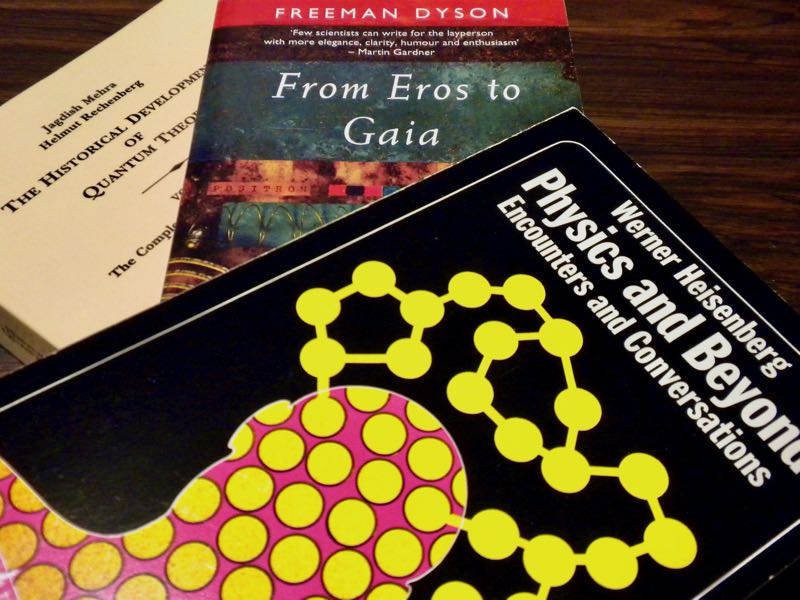
  2. J. Mehra and H. Rechenberg, The Historical Development of Quantum Theory, Volume 6, Part 2 (Springer, New York, 2001). [Note: I happened to have this book because I was attending the "Hideki Yukawa Study Group," once held at the Osaka Science Museum, and thought that it might be useful for discussions there.]
  3. F. Dyson, From Eros to Gaia (Penguin, London, 1993; first published by Pantheon, New York, 1992). [Note: When I was still working, I recommended this book to my colleague Naoki Toyoda (currently Professor Emeritus of Tohoku University). This time I emailed him about the topics related to the present article. Then, he taught me back the presence in this book of the part quoted in the text.]
  4. W. Heisenberg, Physics and Beyond: Encounters and Conversations, translated from German by A. J. Pomerans (Harper & Row, New York, 1972); original German edition, Der Teil und das Ganze: Gespräche im Umkreis der Atomphysik (R. Piper, Munich, 1969); Japanese version, Bubun to Zentai, translated by K. Yamazaki (Misuzu-Shobo, Tokyo, 1974; new edition 1999).
(To be continued)
Search word: Kamefuchi-2020

Sunday, September 06, 2020

On Kamefuchi's Essay about Heisenberg and Yukawa (2)

D. C. Cassidy's Uncertainty: The Life and Science of Werner Heisenberg.

2 Heisenberg's tragedy (continued)

2.3 Heisenberg's research at that time

Kamefuchi calls Heisenberg's research at that time "monistic field theory of elementary particles" and explains it as a big idea to derive all elementary particles starting from a single field (or equation). Then, Kamefuchi stated as follows: "I first learned of this in a newspaper, so he probably made a press conference and announced it. At that time, he might have used the adjective 'universal' for the basic equation, and it was erroneously freported as "the equation of the cosmos" in Japan."

I also saw the newspaper article about this research of Heisenberg and wrote it down in the diary at that time. It was just before my graduation from university. The diary reads:
February 27, 1958
I have found the following article in the Asahi Shimbun:
[Göttingen (West Germany) 25th UP=Kyodo] At the University of Göttingen on the 25th, Professor Heisenberg, Nobel Prize winner in physics of West Germany, gave a lecture entitled "Advancement of Elementary-Particle Theory." He announced that the research group led by him made research on "unified field theory" and found a basic equation that could explain all laws of physics without exception. The theory was the one that Dr. Einstein also thought about. ...

March 13, 1958
[Here is the clipping of the Asahi Shimbun article entitled "This is the equation of the cosmos." It showed the basic formula of elementary particles found by Heisenberg and his coauthors.]
I posted the copy of the diary on a page [5] of my website and destroyed the original diary. So, I do not have the clipping of "This is the equation of the cosmos" but will show the formula copied from another source later. According to the first newspaper article, Heisenberg did not hold a press conference as Kamefuchi supposed, but newspaper reporters listened to his lecture at the University of Göttingen and wrote about it. This is also clear from the following description in the biography of Heisenberg written by Cassidy [6]:
The distribution [of the preprint on work made by Heisenberg and Pauli] was set for February 27, 1958. [...]

Three days before the preprint was to be distributed, Heisenberg announced the new formula in a lecture at the University of Göttingen physics institute. ([6] p. 542)
According to the above description, the day of the lecture was 24th local time, which is different from the date of 25th in the Asahi Shimbun. Is this difference because Asahi Shimbun did not correct the time difference for the news distributed by "UP = Kyodo"?

2.4 "The equation of the cosmos" was not a mistranslation

The description in Cassidy's book continues as follows:
An eager reporter in the audience relayed word of a sensational new "world formula" around the world. One enthused press agent proclaimed, "Professor Heisenberg and his assistant, W. Pauli, have discovered the basic equation of the cosmos!" ([6] p. 542)
This reveals that overseas newspapers also used the term "basic equation of the cosmos," and the expression in the Asahi Shimbun was not a mistranslation.

The Asahi Shimbun separately reported the equation later than the news of the lecture at Göttingen University. Sentences that follow in Cassidy's book explain this to some extent:
Two months later, more than 1800 listeners turned out to hear Heisenberg reveal the secret of the cosmos in the same auditorium on the occasion of Max Planck's one-hundredth birthday. During his highly technical talk, Heisenberg carefully wrote his new equation on the overhead projector in the darkened room:
([6] p. 542)
Heisenberg did not reveal the formula in his lecture at the University of Göttingen in February but only its name. He wrote the equation in another occasion mentioned in the above quote. However, the fact that the second lecture was two months later than the first is not consistent with the time when the Asahi Shimbun reported the equation. The second lecture was to celebrate the 100th anniversary of Planck's birth. So, I looked up his birthday and found that it was April 23. [7] This is consistent with the words, "Two months later," in the above quote. However, it is impossible for the Asahi Shimbun dated March 13 to report the lecture contents of April 23. The lecture celebrating 100 years of Planck's birth might have been made about 40 days earlier than his birthday. Despite this, Cassidy might have imagined that the second lecture celebrating Planck's birth should have been around his birthday.

The basic equation of the cosmos quoted here is the same as that in Cassidy's book but copied from a paper co-authored by Heisenberg and young researchers [7]. I will describe later how I learned of this paper.

Polkinghorne describes Heisenberg's speech at the conference in a little more specialized style than Kamefuchi as follows:
[Heisenberg] had conjectured a 'non-linear spinor equation', whose solutions he thought would correspond to the structure of matter as it was then known. Not only was his equation hard to work with, but in the course of the attempt use was made of the dangerous concept of an infinite metric, something which could result in the appearance of unphysical ghosts. ([4] p. 77)
Heisenberg's equation still had problems though he confidently showed it at the University of Göttingen.

Pauli was a collaborator in Heisenberg's research at that time, as mentioned in the first two quotes from Cassidy's book. Why did he take a rebellious attitude at the international conference? I would like to see this point next.

References
  1. J. C. Polkinghorne, Rochester Roundabout: The Story of High Energy Physics, (W. H. Freeman, New York, 1989) p. 77.
  2. T. Tabata "From Youth Diaries: University Days (5)" (2003), in the Web site IDEA and ISAAC.
  3. D. C. Cassidy, Uncertainty: The Life and Science of Werner Heisenberg (W. H. Freeman, New York, 1991).
  4. Max Planck: Biographical in The Nobel Prize, the Web site of the Nobel Foundation.
  5. H. P. Dürr, W. Heisenberg, H. Mitter, S. Schlieder, and K. Yamazaki, "Zur Theorie der Elementarteilchen," Z. Naturf. 14a, 441 (1959).
(To be continued)
Search word: Kamefuchi-2020

Thursday, August 20, 2020

On Kamefuchi's Essay about Heisenberg and Yukawa (1)

Kamefuchi's essay published in the magazine Tosho

1. Introduction

Recently, I read the essay "The life of heroes" [1] by theoretical physicist and Professor Emeritus of the University of Tsukuba, Susumu Kamefuchi. The heroes mean here two giants in his field, Werner Heisenberg and Hideki Yukawa. What the author writes is "witness testimony" of the heroes' tragedies in their later years.

Heisenberg's tragedy occurred at the International Conference on High Energy Physics held at CERN in July 1958. The chairperson Pauli began to attack violently against his lecture, denying his study [2] altogether.

Yukawa's tragic incident happened at the International Conference on Particles and Fields held at the University of Rochester in August 1967. He was chairing a session, and his collaborator K was going to give a talk on the paper [3] co-authored with the former. Then, most of the audience stood up from their seats and left the room.

The author writes that he was worried about degrading the heroes, but that he recalled it essential to convey the truth.

In the present article, I describe and discuss some of the things I learned from other sources in connection with Kamefuchi's essay.

2 Heisenberg's tragedy

2.1 Description in Polkinghorne's book

Kamefuchi begins to write the stories saying, "these seem not much talked about." However, I recently read the same story about Heisenberg in a book [4]. The author of the book is a British theoretical physicist, theologian, and Anglican priest, Polkinghorne. He describes twenty international conferences on high energy physics from 1950 to 1980 to make this book a unique history book of this field of research. In the book, Polkinghorne writes in a slightly more detailed manner than in Kamefuchi's essay by citing, from the proceedings, Pauli's words of the attack on Heisenberg's speech. The book also has a photo of Pauli at that time, with the caption including his remark, "No credits for the future," on Heisenberg's speech. The story ends with the following words, which are sympathetic to Heisenberg.
It was a scene at once farcical and sad. Justification lay with the sceptical Pauli but Heisenberg was one of the greatest physicists of the twentieth century who should have been able to enjoy a more dignified close to his career. ([4] p. 77)
Readers of this article may wonder that the book on the history of physics contains emotional words, so I would like to add some explanations about the character of this book. This is not a textbook with an objective description or a non-emotional scholarly book, but a book for the general public. (The general public here might be limited to those who are mainly interested in science. I read this book as a person who thinks high energy physics as one of his hobbies.) Thus, the descriptions in this book are rather light-hearted and make fun reading materials that convey the atmosphere of the conference and the characteristics of famous scholars. We can also infer the nature of this book from the fact that the title and subtitle include the words "roundabout" and "story," respectively.

2.2 Chair Pauli's assault

Kamefuchi describes the chair Pauli's behavior as follows [1]: "He stood up, spoke in place of the speaker, behaved increasingly violent, and got so abusive as I have never heard in a physics conference." Some may wonder: Why did no participants protest the chair's behavior? The answer can be imagined from the following. Before the above description, Kamefuchi writes as follows: At the beginning, the chair Pauli, who was well known for his harshness, expressed the following introductory words, "I don't think there are any new ideas, but I'll open the session anyway."

Polkinghorne writes these Pauli's words in more detail and once again gives his personal opinion:
It would be of no use waving your hands in front of him and expressing the hope that it would all work out right in the end. ([4] p. 77)
At this point, Pauli already brought the entire audience to his knees, and no one could dare to advise him, who was famous for his effective spiciness.

References
  1. S. Kamefuchi, Tosho No. 859, pp. 18–22 (2020).
  2. W. Heisenberg, "Research on the non-linear spinor theory with indefinite metric in Hilbert space" in 1958 Annual International Conference on High Energy Physics at CERN, pp. 851–857 (CERN, Geneva, 1960).
  3. Y. Katayama, "Space-time picture of elementary particles" in Proceedings of the 1967 International Conference on Particles and Fields, Ed. C. R. Hagen, G. Guralnik and V. A. Mathur (Interscience, New York, 1967) p. 157.
  4. J. C. Polkinghorne, Rochester Roundabout: The Story of High Energy Physics, (W. H. Freeman, New York, 1989) p. 77.
(To be continued)
Serch word: Kamefuchi-2020

Thursday, May 23, 2019

My Thought on Goro Shimura


Shimura's autobiography written in Japanese.

Goro Shimura, Princeton’s Michael Henry Strater University Professor of Mathematics, Emeritus, died on Friday, May 3, in Princeton, New Jersey, at the age of 89 (Ref. 1). I found a blog (Ref. 2) intended to honor Shimura’s life and legacy and wrote my thought on him there. My contribution (the second entry in Ref. 2) is quoted below.

It is quite sad to hear about the passing of Professor Shimura, but his legacy will continue forever through his achievements.
A little relationship between Professor Shimura and me is as follows: Haruko Iwasaki, who is one of my classmates in elementary school and was a professor of Japanese language at Princeton University in her thirties, was once invited to Professor Shimura’s home because of their common native country. After moving to the University of California, Haruko got a copy of Professor Shimura’s autobiographical book, “The Map of My Life” (Springer, 2008), from a person who came from an overseas country. This happened because the latter heard that the former had been an acquaintance with Professor Shimura at Princeton University. After that, Haruko became Professor Emerita, came back to Japan, and gave me the book, saying “You’re the only scientific person I know in Japan.” I enjoyed the book very much and wrote a review of it (https://ideaisaac.blogspot.com/2011/10/mathematicians-unique-autobiography.html) with the bottom line, “Most books I read in the afternoons this summer and early autumn made me sleepy, but Shimura’s autobiography was a complete exception.”

References
  1. Liz Fuller-Wright, “Professor Emeritus Goro Shimura 1930–2019,” https://www.math.princeton.edu/news/professor-emeritus-goro-shimura-1930-2019.
  2. In Memoriam • Princeton University Employees, https://blogs.princeton.edu/memorial/2019/05/goro-shimura/.

Monday, July 13, 2015

From Fujioka's Fluid Drop Model of Atoms to Einstein–Arakatsu Relationship

I have made a lot of exchanges with Bill Streifer (a researcher and freelance journalist on Intelligence, nuclear work and North Korea) at the Quora site from July 9 to 13, 2015. Most part of our exchanges is reproduced here by Bill's permission.


Bill: Was Prof. Yoshio Fujioka's "fluid drop" model of the atom known as ekiteki?
And if so, why?

Tatsuo: I haven't learned about Yoshio Fujioka's "fluid drop" model of the atom but guess that if he proposed such a model, it should have been called "ekiteki" model. "Ekiteki" is the Japanese word for "fluid drop" (eki=fluid, teki=drop).

Bill: Prof. Ayao Kuwaki was a Japanese scientist and a friend of Albert Einstein. When did he die, exactly?

Tatsuo: According to the information page of him in "Wikipedia" (Japanese edition), Ayao Kuwaki was born on September 9, 1878, and died on May 16, 1945.

Bill: At the end of the war, an American airman met a man who claimed to be a student of Einstein in Germany. When I learned of Kuwaki, I suspected it might have been him. But now I see that's not possible since Kuwaki died in May 1945 and the "meeting" took place in September 1945.

Tatsuo: Sure, the student should not have been Kuwaki.

Bill: He might not have been a graduate student of Einstein, but he may have attended Einstein's lectures in Germany. Can you guess who he might have been? [And he lived in northern Korea in 1945!] An Einstein scholar is not willing to guess.

Tatsuo: I have no idea about that person.

Bill: If you provide a number of possibilities, I'll check each one. Did Hideki Yukawa study under Einstein?

Tatsuo: No, Yukawa didn't study under Einstein, but they met each other for the first time in Princeton on the former's return trip from Europe in 1939.

Bill: Einstein wasn't in Germany very long. I wonder if any Japanese or Korean scientists studied under Einstein when he taught there, or even attended his lectures.

Tatsuo: The Japanese physicist Jun (Atsushi) Ishiwara seems to have studied under Einstein in Germany (石原純 - Wikipedia). Ishiwara worked as an interpreter when Einstein visited Japan in 1922.

Bill: Thanks. Did Einstein have other Japanese students or followers in Germany? Kuwaki appears to be a little too old. I'm looking for a Japanese scientist who lived until 1946 at least.

Tatsuo: I don't think that Einstein had other Japanese students or followers in Germany.

Bill: I know of another.

Tatsuo: You Know? Who is he?

Bill: Dr. Bunsaku Arakatsu.

Tatsuo: Oh, Bunsaku Arakatsu was a teacher of my teacher and an experimental physicist. So, I didn't think he had studied under Einstein. Wikipedia page for him (Japanese edition) writes that he studied in Europe (Berlin, Zurich and Cambridge) for two years from 1926. It must have been a short time during this period that he studied under Einstein. By the way, his look is similar to Einstein's in some photos of him.

Bill: Can you find any photos of Einstein and Arakatsu together? If you can, please send them to photografr7@yahoo.com.
Is your teacher still alive? If so, could you ask him if Arakatsu or Yukawa visited Konan (Hungnam), Korea during the war? By the way, Konan and Hungnam are the same place, Konan is the Japanese pronunciation and Hungnam the Korean pronunciation.
You might also be interested in knowing that my article about an Austrian chemist who worked at Konan for more than two years (1935-1937 & 1940), will appear in a book being published by the University of Vienna Korean Dept. later this summer. The name of my article is A Letter from Korea.

Tatsuo: I don't have any photo of Arakatsu.
My teacher Kiichi Kimura at Physics Department, Kyoto University died in 1992. I haven't heard of Arakatsu's or Yukawa's visit to Hungnam (Konan), Korea. However, Arakatsu was associated with another Konan. Namely, he was the president of Konan University in Kobe, Japan, after his retirement from Kyoto University. Konan of Korea and Konan of the university in Kobe are different from each other when written in Chinese characters. The former Konan is written as 興南, and the latter, 甲南.
I have not so much interest in the history of science in Korea. However, if you write about some history of physics in Japan, I would like to read it very much.

Bill: I am familiar with Kimura. I am also aware that Konan, Japan is different than Konan, Korea.

Tatsuo: May I quote our exchanges made here these days in one of my blog sites written in English? Some friends of mine might be much interested in our exchanges.

Bill: Yes, that would be fantastic. And if anyone has any questions or comments, they can contact me directly at bill.streifer@gmail.com.

Tatsuo: Thanks a lot for your permission.

Bill: Stay in touch.

—A few days later we had additional exchange as given below.—

Bill: You can add this: According to page 15 of the book Uranium Matters: Central European Uranium in International Politics, 1900–1960 by Zbyněk A. B. Zeman and Rainer Karlsch, the Japanese physicist, Dr. Bunsaku Arakatsu "studied at Berlin University ... under Einstein, becoming a member of Einstein's close circle of friends."

Bill: I returned to the original document, and I am now convinced that the American airman met a Korean scientist, not a Japanese scientist in Korea in September 1945. But it's still interesting that Arakatsu was a close friend of Einstein, so all of this work wasn't for nothing.

Tatsuo: I've been on a trip to my hometown since Tuesday and am writing a belated reply. Thanks a lot for your additional information. We surely have gotten a good fruit.

(Last modified on July 29, 2015)

Thursday, May 09, 2013

Yukawa's Utushi-e

When I read the English translation, by L. Brown and R. Yoshida, of Yukawa's autobiographical book Tabibito, I found many errors and sent a list of corrections to Brown. The list included shadow pictures as the translation of "うつしえ (utsushi-e)." Yukawa mentioned it together with ground-cherries and Kintaro wheat-gluten bars, etc. as things sold at street-stalls at a fair in his childhood. Utsushi-e meant both shadow pictures (写し絵) and transfer pictures (移し絵), but shadow pictures are played rather than sold. So, I thought the correct translation of utsushi-e should be transfer pictures but was not confident about this. In my childhood transfer pictures were surely popular among children. In the days when Yukawa was a child, however, sheets for shadow pictures (the equivalent to slides of the present days) might have been sold, and they might have enjoyed a picture show by passing lamplight through them. (This story was given in Part I, Chapter 1, of my book Passage through Spacetime.)

Recently I read Soseki's autobiographical novel Michikusa and found the following passage:
Of course, he was able to get whatever toys he wanted. Tools for utsushi-e (写し絵) were also included in it.
In Notes section at the end of Michikusa, the following description is given about utsushi-e:
The thing that reflects pictures drawn on glass onto a screen made of cloth or paper, in the dark; a magic lantern.
These indicate that the shadow picture was one of popular toys in Meiji period, to which childhood days of both Soseki and Yukawa belonged. Soseki was born in 1867; Yukawa, in 1907; and I in 1935. As for the year of birth, therefore, Yukawa and I are closer than Soseki and Yukawa. However, there was a big change of cultural environments when electric lights spread through the country [an almost full spread in Tokyo was achieved in 1912 (Ref. 1)]. In my childhood, I saw a projector of 8-mm film in a nearby home already being used instead of a magic lantern. Thus, Soseki and Yukawa had much in common in their childhood, and I have to admit that the translation, "shadow pictures," by Brown and Yoshida was quite right.

Reference
  1. Chronology of electricity from Taisho to Showa, A Web page of the Federation of Electric Power Companies of Japan.

Saturday, May 05, 2012

Small Relationship between the Late Physicist Tonomura and Me

On Wednesday, May 2, mass media reported the following news:
Physicist Tonomura dies at 70
A fellow at electronics giant Hitachi Ltd. tipped as a future Nobel Prize winner for years, Akira Tonomura died of pancreatic cancer early on May 2, 2012, at a hospital in Saitama Prefecture. He was 70. Tonomura was known for developing electron holography for observing microscopic structures in matter using the wave nature of electrons and confirming the so-called Aharonov-Bohm effect, the existence of which had long been disputed among physicists. (Kyodo)
An obituary of Tonomura also appeared at the Web site of European Superconductivity News Forum. Besides his achievements described in the above report, the experiment in which Tonomura and his coworkers showed the quantum interference of single electrons is famous because Robert Crease mentioned it in his book "The Prism and the Pendulum: The Ten Most Beautiful Experiments in Science" (Random House, 2003; paperback, 2004). We can see the movie of this experiment in the video of Tonomura's lecture delivered at the Royal Institution in 1994. It is quite a pity that the possibility of Tonomura's receiving Nobel Prize was lost by his passing.

I exchanged email messages with him once. Within one and a half hours, he replied to my pointing out of a minor error in his review paper written in Japanese, showing his sincere personality. In order to make him learn, if he wanted to do so, what a person I am, I appended the URL of my homepage at the end of my message. So, he browsed the homepage and, unexpectedly, wrote words to praise it (regrettably, I am not updating the homepage these years). I would like to express my condolence by quoting our email messages below:

From: Tatsuo Tabata
To: Akira Tonomura
Date: Date: Thu, 6 Jan 2005 08:01
Subject: Some words about "Quantum mechanics: Japanese contributions to its fundamentals"

Dear Dr. Tonomura,

I read your article published in Butsuri Vol. 60, No. 1, p. 3 and learned much from it. I am only afraid that the expression, "S. Weinberg who made the final theory and got Nobel Prize," in line 8 of the second paragraph, Chapter 1, is not correct. Surely, Weinberg published a book entitled, "Dreams of a Final Theory" (1992; paperback 1994). However, such a theory is yet dreams of physicists, just as the whole title of his book indicates. What is made by Weinberg and Abdus Salam independently and extended by Sheldon Glashow is the unification of electromagnetism and the weak interaction, and it is part of what is called the Standard Model.

We hear that the purpose of the series of papers "Physics in Japan: The Past 100 Years and the Prospect," of which yours is one, is "to tell the public about the deep interest and charm of physics." Then, it would extremely be important to describe correctly even about minute points. I would like to recommend you to publish a correction in the next issue.

Sincerely,
Tatsuo Tabata
Home page, http://www3.ocn.ne.jp/~tttabata/

(Originally written in Japanese)


From: Akira Tonomura
To: Tatsuo Tabata
Date: Thu, 6 Jan 2005 09:28
Subject: Re: Some words about "Quantum mechanics: Japanese contributions to its fundamentals"

Dear Professor Tabata,

Thank you for your email message in which you pointed out an error in my paper. Surely, the expression, 'S. Weinberg who "made" the final theory and got Nobel Prize,' is incorrect. Passages of the paper have been much modified by the instruction of the editorial committee that senior high school students should be able to understand them. Therefore, I would like to consult a member of the committee to publish a correction.

I have browsed your home page and been much impressed to learn that it contains newest information not only about science but also other wide fields. I hope that your activity proceeds further.

Thanking you again for your message,

Sincerely,
Akira Tonomura

(Translated from Japanese by T. T.)

Thursday, January 26, 2012

Hans Svensson (1935–2011)


On January 23, 2012, I received an email message with an attachment from my former coworker Pedro Andreo in Stockholm. The attachment was a PDF file of the latest issue of European Medical Physics News [1], in which the report of interview with him [2] and a page in memory of Hans Svensson [3] were contained. Pedro is one of two authors who wrote about memories of the Swedish radiation physicist Svensson on that page.

Searching on the Internet, I found the report "Hans Svensson — In memoriam" [4] written in Swedish. According to the report, Svensson died on December 7, 2011, after a short illness. He was born on March 18, 1935, and began his academic career as a student in Lund in 1956. In 1963, he came to Umeå as a medical physicist and received his doctorate there in 1970 in the subject of radiation physics. In 1982, he became full-time professor of radiation physics associated with the mission of an operation manager, a position he held until his retirement in 2000. During his career, he had significant international commitments and received a number of prestigious awards. He has been active professor emeritus at Umeå University since 2000.

Pedro praises Svensson's work done as the Chairman of Report Committee for ICRU Report 35 [5] by the words "probably his greatest single achievement" [3]. I learned Svenssons's name well before the publication of this report, probably by ICRU Report 21 [6], which was the earlier version of ICRU Report 35 with an essentially same title as that and contained seven papers of Svensson's group in its list of references.* I talked with Svensson twice, once on a day of the International Conference on Radiation Research held in Tokyo in 1979 and next in his office at IAEA in May 1989 (the above photo was taken on the latter occasion). Both our meetings were of a short time, but I vividly remember his kindness. Indeed, it was he who gave me helpful advice to cooperate with Pedro.** I sincerely pray for Hans Svensson to sleep peacefully in heaven.

References
  1. European Medical Physics News, Winter 2011/12 (2012).
  2. "Pedro Andreo — the road to and through Medical Physics," ibid. p. 6.
  3. "Hans Svensson — one of the Pioneers in our field," ibid. p. 23.
  4. M. Karlsson, "Hans Svensson — In memoriam," Web page of Radiofysik.org (2012).
  5. Radiation Dosimetry: Electrons with Initial Energies Between 1 and 50 MeV, ICRU Report 21 (International Commission on Radiation Units and Measurements, 1972).
  6. Radiation Dosimetry: Electron Beams with Energies Between 1 and 50 MeV, ICRU Report 35 (International Commission on Radiation Units and Measurements, 1984).
Notes
* By the way, the list of references in ICRU Report 21 also contained six of our papers on the work done at Radiation Center of Osaka Prefecture; and a similar list in ICRU Report 35, five later papers on our work.
** The collaboration produced 11 papers published in refereed journals in the period 1991–1998.

Friday, November 18, 2011

The Japanese Theoretical Physicist and Poet, Jun Ishiwara


The cover of the book "Pioneer of Science Journalism: Biography of Jun Ishiwara."

The book entitled "Pioneer of Science Journalism: Biography of Jun Ishiwara" [1] was published recently, and I read a review of it [2]. The reviewer, Atsuko Tsuji, first writes as follows:
The name "Jun Ishiwara" seems to be unfamiliar to many people. So, the title of the book "Pioneer of Science Journalism" might be somewhat misleading.
I am quite familiar with that name, thus probably being one of the few such people now. "Nihon Shokokumin Bunko)" (a series of books for children) was published in 1936, and its revised edition was issued after World War II. Then I was in the sixth grade of the elementary school or the first grade of the junior high school and liked to read that series. The author of its seventh volume "Mysteries of the World" (1948, Shincho) was Jun Ishiwara. I learned atoms and molecules from that book. In addition to the effect of this book, Hideki Yukawa's winning of the Nobel Prize (1949) made me walk on the way to physics.

The aforementioned review article continues as follows:
As noted at the beginning by the author, he was one of the best theoretical physicists. In the early twentieth century, he first published first papers in Japan on relativity and quantum theory, which brought about a revolution in physics, and led discussion in the country.
This description reminded me of the fact that one of Ishiwara's article (written in German) was included in "History of Physics in Japan, Vol. 2: Reference Materials" [3]. In this book, Ishiwara's paper [4] is introduced by the following words:
This is the work in which Ishiwara (1881–1947) generalized the quantum rule independently of W. Wilson and A. Sommerfeld.
The same paper has also been mentioned in Ref. 5. Reference 3 also includes Ishiwara's two articles written in Japanese [6, 7].

The reviewer then writes, "He is also a tanka poet. . . ." After that, the following statements come:
It is even a surprise that the name of such a scientist is little known.
The love affair of Ishiwara, who had a wife and children, became a scandal, and he retired from the professorship at Tohoku Imperial University at the age of 42. Is this related to the unfamiliarity of him to people? After retirement, he pulled himself from research and became a person to discuss and communicate about science.
Ishiwara's love affair, together with his activities as a poet, is described in some detail in "Wikipedia" [8].

The review concludes by the sentence, "His life and words give us great suggestions about how the present-day science and scientists should be." I certainly want to read the book reviewed.

References
  1. S. Nishio, "Pioneer of Science Journalism: Biography of Jun Ishiwara," (Iwanami, 2011) In Japanese.
  2. A. Tsuji, "True scientist who discussed how physics should be," Asahi Shimbun (November 13, 2011) In Japanese.
  3. Physical Society of Japan, ed., "History of Physics in Japan, Vol. 2, Reerence Materials" (Tokai University Press, 1978) In Japanese.
  4. J. Ishiwara, "Die universelle Bedeutung dse Wirkungsquantums," Tokyo Sugaku Buturigakkai Kizi, Ser. 2, Vol. 8, pp. 106–116 (1915).
  5. H. Rechenberg, "Quanta and Quantum Mechanics," Chapter 3 in Twentieth Century Physics, Vol. 1, L. M. Brown, A. Pais and B. Pippard, ed. (Institute of Physics, 1995). pp. 143–248. (See p. 175 for Ishiwara.)
  6. J. Ishiwara, "Impression of Einstain," in Einstein and Relativity, J. Ishiwara (Kaizo, 1921) pp. 137–160. In Japanese.
  7. J. Ishiwara, "Earthquakes and science education," in Modern Natural Science, J. Ishiwara (1924) pp. 133–152. In Japanese.
  8. "Jun Ishiwara," Wikipedia, Japanese edition (November 16, 2011).

(A correction for Ref. 5 made on August 23, 2012.)

Friday, October 28, 2011

A Mathematician's Unique Autobiography


The other day, I phoned Haruko Iwasaki to tell how I enjoyed the class reunion of our elementary school, at which she had not attended because of difficulty in walking due to Parkinson's disease. On that occasion, she said to me, "I'll give you a book written by the famous mathematician Shimura-san because you're the only scientific person I know in Japan. Do you know the name Goro Shimura?"

Haruko worked at Princeton University, Harvard University, and the University of California on Japanese language and Japanese literature; and now lives in Kobe after becoming Professor Emerita at the final workplace. She got a copy of Shimura's book in California from a person who came from an overseas country. This happened because the latter heard that the former had been an acquaintance with Shimura at Princeton University.

When I talked by phone with Haruko, I did not remember the name Goro Shimura and said, "No, I don't." After getting the book, however, I had the following thought: His name is probably related to Fermat's last theorem. I possessed a book, Fermat's Enigma: The Epic Quest to Solve the World's Greatest Mathematical Problem (Walker, 1997) written by Simon Singh but had not read it yet. Browsing some pages of Singh's book, I confirmed that my memory was right.

The book Haruko gave me is Shimura's autobiography entitled The Map of My Life (Springer, 2008). Shimura's English is readable, and his observations are unique. Some anecdotes of luminaries are also included. Mathematically-minded people should not expect to learn about algebraic geometry or such from this book. However, he depicts a rough outline of his research and what is valuable in the investigation of mathematics as well as memories of Taniyama, who contributed to finding Taniyama-Shimura conjecture (now called modularity theorem, which had a crucial role in the proof of Fermat's last theorem accomplished by Andrew Wiles). Therefore, those people, as mentioned above, would also be able to enjoy this book.

Goro Shimura was born in 1930. So, he is older than Haruko and I by five years only. Interestingly, however, she had the impression that he might be older than her by one generation, like Hideki Yukawa, possibly because of his elderly manner of speaking and impressive accomplishments achieved already at his young ages. Haruko told me that Shimura's look was like a noh mask. We can confirm this to be true in a sense by a full-page sized portrait of him on page 172 of Singh's book mentioned above.

Haruko also told me that Shimura used to recite rōkyoku or something like that for his friends without attaching the melody and that he was interested in porcelain. In fact, he published the book The Story of Imari: The Symbols and Mysteries of Antique Japanese Porcelain in 2008.

At the beginning of the book, Shimura writes about the daily life in Tokyo and things related to it in the 1930s, for the reason that those "things completely ordinary and known to almost everyone" of his generation "will never be written, and as a consequence, will be forgotten" (page 1). Reading them with a nostalgic feeling, I thought that he also did an excellent job here. He quotes from one of the light kinds of music "that were not so objectionable": "La, la, la, red flowers carried on a wagon, / Spring has come from the village to the town, / ..." (a skillful translation from Japanese, perhaps made by himself; page 14). He does not write the title of this song, but I was able to figure it to be "Haru no uta ('The song of spring' sang by Mitsuko Tsukimura in 1937)" because it was one of my favorite songs.

Shimura's finding of the practice of people in Kyoto is also fascinating: "I later learned that false compliments and even false invitations expecting declination were common in Kyoto" (page 30). (By the way, Haruko asked me to visit her someday. She is not the person of Kyoto. So, I do not think it a false invitation.) He shows keen insight into the history of politics, writing a little about possible war responsibilities of Hirohito (page 37) and stating that there is no justification for the second atomic bomb on Nagasaki (page 57). However, I think it to be unfortunate that he seems to be an anti-Marxist. He confuses the Marxism with the dictatorship by the Communist party in the former USSR and North Korea (page 86).

Shimura's scathing remark about the famous Japanese mathematician Teiji Takagi at the latter's old age might surprise Japanese readers, because the former quotes the words, "Kunshi is peaceful and not arrogant, whereas shojin is arrogant and not peaceful," from The Analects of Confucius to mean Takagi was shojin (page 117). He also criticizes G. H. Hardy's following words in A Mathematician's Apology as "rather pompous" (page 161): "No mathematician should ever allow himself to forget that mathematics, more than any other art or science is a young man's game." I do not think that these criticisms by Shimura themselves pompous but believe that they reflect his attitude not to be subservient to the authority and his determination to continue working on mathematics till old ages.

As for the work of mathematics, many mathematicians think, "The more difficult, the better." Shimura's view is different from this. He attaches importance to the significance of the result in the development of mathematics rather than to the difficulty of deriving or proving the result (page 137 and on some earlier pages). From the viewpoint of me as a physicist, this seems to be quite reasonable.

I have to add the following bottom line: Most books I read in the afternoons this summer and early autumn made me sleepy, but Shimura's autobiography was a complete exception.

I thank Yoshihiro Matsumori for our conversation on the message page of Facebook, which became the motive of writing this blog post.

(Modified May 16, 2019)

Sunday, September 04, 2011

Hideki Yukawa's Lindau Lecture

Reading a Scientific American article on the 61st Annual Lindau Nobel Laureate Meeting [1], I have learned the home page The Nobel Laureate Meeting at Lindau [2]. Scrolling the page downwards, we see a link to the Lectures Online page. There we can listen to more than 100 lectures of Nobel Laureates online. Among those lectures, I have found Hideki Yukawa's speech at the 3rd Lindau Nobel Laureate Meeting (1953, 1st Meeting in Physics) entitled "Attempt at a Unified Theory of Elementary Particles." Instead of the abstract of his presentation, a brief introduction is given by the editor Anders Bárány.

Bárány writes that Yukawa's full written lecture can be found in a special publication of the journal Naturwissenschaftliche Rundschau from 1981 and that the printed version contains a number of rather complicated equations not shown during his speech in Lindau. The Japanese version of the full written lecture appeared in November 1953 issue of Shizen and was reprinted in the special number for Yukawa memorial of the same journal published in November 1981.

Here are essential words from Bárány's introduction:
This was a time when one of the main problems in physics was the large number of elementary particles detected in cosmic rays and in high-energy accelerators. [. . . T]he problem was that, as Yukawa phrased it in his lecture, "Powell discovered a great number of extra particles which I did not need." Today we have the Standard Model of particles and forces, through which all the “extra” particles can be classified and all the forces computed. But we still miss what Yukawa was looking for in his attempt to formulate a unified theory of elementary particles [. . .]
Yukawa's attempt at that time was in the direction of nonlocal field theory.

There was a rumor that Yukawa's spoken English had the intonation of the Kyoto dialect. Listening to his Lindau lecture, I do not think so. His voice in this talk sounds young (he was 46 years old at that time) and fairly similar to the voice of his son, Taka'aki, whom we can listen to in the narration of the video The Yukawa Story [3]. I also think that Yukawa's talk in English is more listenable than his lecture in Japanese at the classroom of the university.

I owe to Mr. M. M. for the information of the Japanese version of Yukawa's written Lindau lecture.

  1. S. Mirsky, Noble Nobel faces: A week in Lindau, where scientists are celebrities. Scientific American (September 1, 2011); printed version, September issue, page 78 (2011).
  2. The Nobel Laureate Meeting at Lindau: Educating, Inspiring, Connecting scientific Generations since 1951, www.lindau-nobel.org.
  3. The Yukawa story, You Tube video (uploaded on December 23, 2009).

Monday, May 02, 2011

The Disaster Report from Tohoku University

Coming back from a bus trip to Okayama Prefecture late last evening, I found an email massage from a former colleague of mine, Naoki Toyota, who is now Professor at Department of Physics, Tohoku University. He writes as follows:
Find the file attached, "The March-11 disaster report from Sendai." I have sent this nonofficial, rather personal document to my overseas friends and asked them for distributing it to their colleagues. I would appreciate it if you could upload this email on your home page or provide a link to the URL of the report (a link to the home page of our Low-Dimensional Quantum Physics Group is also okay).
By the way, all my family including my mother-in-law and her family, living in the devastated coastal region, are safe.
Naoki's report consists of four pages of a PDF file and describes the damage caused by Tohoku earthquake and tsunami, as well as the status of recovery from it, at Tohoku University. Especially, detailed descriptions are given of those at Department of Physics and related facilities.

Just after the March-11 disaster, I thought of sending Naoki an email message of sympathy. However, I supposed that he might be busy responding to many similar messages (even I, living quite far from Tohoku, received some such messages from abroad). Thus, I refrained from sending a message. On the return path of yesterday's trip, I was thinking about sending him a note during this week. What an interesting phenomenon of synchronicity it is to find his message after returning home!

Sunday, December 26, 2010

Fumiko Yonezawa Reviews the Japanese Edition of The Strangest Man


The Strangest Man: The Hidden Life of Paul Dirac, Mystic of the Atom (Basic Books/Perseus Book Group), written by Graham Farmelo, was the winner of the Costa Book Award for Biography and the Los Angeles Times Book Prize for Science and Technology, in the year 2009 of its publication. This book was also selected as one of the best books of 2009 by The Economist, The New York Times Book Review and Amazon.com. The Japanese edition of the book was published by Hayakawa Shobo, Tokyo, in September 2010. The translator was Michiyo Yoshida. The Japanese title is not the literal translation of the original but means, "The Sea of Quantum, Dirac's Abyss: The Highly Gifted Physicist's Glorious Achievements and Reticent Life."

Fumiko Yonezawa's review of the Japanese edition has appeared in The Akahata. This is the first review of it I have seen in the mass media. Fumiko Yonezawa is Professor Emeritus of Keio University, the first woman President of the Physical Society of Japan and one of the laureates of L'ORÉAL-UNESCO for Women in Science Award 2005, for her pioneering theory and computer simulations of amorphous semiconductors and liquid metals.

The Akahata or Shimbun Akahata (literal translation, Newspaper Red Flag) is the daily organ of the Japanese Communist Party in the form of a national newspaper. Started in 1928, Akahata has a 16-page daily edition and a 36-page Sunday edition, and the total circulation is 1.68 million (quoted from "Shimbun Akahata," Wikipedia, 7 December 2010 at 20:41). I subscribe to two newspapers in order to get deep and balanced view of politics in Japan; one is the "national newspaper," The Asahi, and the other is this Akahata. The latter often carries more excellent articles not only in politics but also in science and culture than "national newspapers." The review by Yonezawa has been printed on one of two-page "Books" column of the issue of Sunday, December 26, 2010, of the daily edition.

The title of the review in literal translation is "The group of scientists depicted elaborately," though the treatment of the book is centered on Paul Dirac. First, she introduces Dirac as a British theoretical physicist and one of the contributors to the establishment of quantum mechanics. Then, she praises his mathematical method of describing quantum mechanics as the most beautiful and his book Quantum Mechanics as the most outstanding among similar books. Especially, she notes that Dirac's book does not have any diagrams, includes a minimum necessary number of equations and many explanations by words like a book of philosophy. She even devotes a paragraph to describe how she enjoyed Dirac's book in her student days, being enchanted by and intoxicated with the beauty of the system he developed.

Next comes a brief introduction of Dirac again (namely, "he got successful results in young days and received Nobel Prize at the age of 31"), and the book being reviewed is mentioned as the biography of Dirac, consisting of more than 600 pages in the Japanese edition. Yonezawa writes that she liked the detailed depictions of the group of scientists in the ages of the formation of quantum mechanics and succeeding to it (the title of the review comes from her words here). She mentions about Dirac's extreme reticence and infers that only the truth of nature and equations would have been swirling in his brain. She quotes the following episode as contrary to this character of Dirac: When Peter Kapitza, a scientist friend of his from Russia, was forbidden to depart from the Stalinist Soviet Union, Dirac was busy trying to collect signatures from physicists for the request of release.

Finally, Yonezawa refers to Dirac's belief, "Physical laws must mathematically be beautiful," and concludes that everything of the physicist Dirac is described in this book. This is a relatively short review but invokes the readers' interest in the person of Dirac quite well so as to make them want to read this book.

Friday, December 03, 2010

About a quote from Marie Curie

Madame Marie Curie: Science is essentially international, and it is only through lack of the historical sense that national qualities have been attributed to it. (iWise Wisdom Web page)
With regard to the purposes, efforts and benefits of science, these words of Marie Curie are valid. Thus, I do not think it appropriate, for example, to count numbers of Nobel-prize winners in science by nationality. However, the quote does not necessarily mean that science is a-cultural. Scientific activity is part of human culture, so that regional flavors are sometimes observed in the methods of doing science. Such flavors should be valued. (Adapted from my post on the above iWise Wisdom page.)

Note added later: By the way, I found the book, Radioactive: Marie & Pierre Curie: A Tale of Love and Fallout" by Lauren Redniss, among Amazon.com editors' picks for the best books of December 2010. I like Richard Rhodes's words of review, "Absolutely dazzling. Lauren Redniss has created a book that is both vibrant history and a work of art. Like radium itself, Radioactive glows with energy."

Saturday, June 26, 2010

The Mystery of Yukawa's "New Insight" (Second Revision)

Hideki Yukawa described the climax of the development of his meson theory in his autobiography Tabibito [1]. However, this description is contradictory to the record of his academic presentation made more than a year before the date of climax. Study on this problem has revealed that two factors were responsible to this contradiction.

Yukawa's passage we treat is the following:
The crucial point came to me one night in October. The nuclear force is effective at extremely small distances, on the order of 0.02 trillionth of a centimeter. That much I knew already. My new insight was the realization that this distance and the mass of the new particle that I was seeking are inversely related to each other. Why had I not noticed that before?
"October" in this quote means that of 1934 according to the paragraph that precedes it. Note that his new insight means the realization of the inverse proportionality of the effective distance of the nuclear force (the force that binds neutrons and protons in the nuclei) to the mass of the new particle that mediates this force. Hereafter, we call this inverse proportionality distance-mass relation.

On the other hand, Yukawa made his first oral presentation at a meeting of the Physico-Mathematical Society of Japan held in Sendai in April, 1933. The title of the presentation was "A consideration about the problem of electrons within nuclei," and its abstract includes the following sentence [2]:
From the fact that the electron has the rest mass, we consider that the strength of the interaction decreases rapidly, as the distance between the neutron and the proton becomes large compared with h/(2πmc).
Here, we find that Yukawa used the distance-mass relation already in 1933. Thus, it is contradictory to call the realization in 1934 of this relation "my new insight".

We guess that the following two factors were responsible to the above contradiction.

1. Hisao Sawano of the Assahi Shimbun Company helped the publication of the Japanese version* of Tabibito by editing Yukawa's manuscript [3]. If Sawano's editing had been to such an extent as to change Yukawa's original version into more dramatic one here and there, then Sawano must have modified the passage about the climax without thinking that his change might contradict Yukawa's academic record.

2. In the work of his 1933 presentation, Yukawa treated the possibility that the electron might be the mediator of the nuclear force. This hypothesis included difficulties related to the spin and statistics of the electron. Therefore, Yukawa abandoned the hypothesis soon later. At the same time, he might also have discarded the distance-mass relation. If so, Yukawa had to rediscover it for completing the paper on the meson theory.

There are two accounts that support factor 1. One of them is Yukawa's passage in Ref. 4. He describes there that he finished writing the last section related to the discovery of the meson theory just a few hours before his trip to Europe. Perhaps, Yukawa regularly checked the changes made by Sawano in order for those not to be contradictory to facts. As for the last section, however, it is quite possible that Yukawa's trip to Europe made such a check impossible.

The other account is in the autobiographical book** [5] of Hideki Yukawa's wife, Sumi. She wrote about the days of their visit to Stockholm for Hideki's receiving Nobel Prize. On arriving at a hotel there, they found that many journalists were waiting to interview Hideki. Sumi's passage about part of the interview is as follows:
One of the questions addressed to him was this: "We hear that the Japanese people study sitting on their legs in a straw-matted room. Did you, Dr. Yukawa, write your paper sitting on your legs or sitting on a chair at the Western-style desk?" Hideki thought a little while and said, "I did in neither of those ways. I put my thoughts together at night in bed." This is true. Hideki wrote the paper that brought him Nobel Prize after he had kept thinking many nights at the age of 27 in the year of Shōwa 9 [Note by the translator: 1934]. This story seems to have wrongly come across to Japan. Thus, in Japan they believe that the idea flashed to him in the middle of a night.

This passage makes us think that the description in Ref. 1 about the sudden coming of the crucial point one night was a modification by Sawano, because it resembles the wrong information conveyed from Sweden to Japan. Further, we can consider that Sumi here denied the modified description indirectly. However, we should note Sumi's possible denial refers, in a strict sense, only to "that the idea flashed to him in the middle of a night." This is not relevant to the essential point of the contradiction, because what is contradictory is the content of the "new insight." This content is highly technical and possibly beyond Sawano's ability of rewriting. Therefore, factor 1 alone cannot be the cause of the contradiction.

With regard to factor 2, we find a strong support for this in Ref. 6, where Kawabe and Konuma write as follows:
In the manuscript of the presentation of April 1933, Yukawa corrected his idea in the abstract to read "the actual calculation does not yield this result." Further, in the draft "Bose electron theory" written almost at the same time as the above manuscript (it had been preserved in the file "Manuscripts of seminars and colloquia, 1934–1935"), he wrote, ". . . the term including the Compton wavelength of the electron appears as a kind of phase factor, . . . and, as a consequence, we cannot say the force decreases rapidly with increasing distance."
The above quote clearly shows that Yukawa once fully discarded the distance-mass relation and that the rediscovery of it was necessary.

The words "My new insight" in the quote from Ref. 1 is not the literal translation of the original words. The literal translation of the relevant passage would be as follows:
One night in early October, a thought flashed through my mind. The nuclear force has only an extremely short effective range. It is on the order of 0.02 trillionth of a centimeter. This has been known since earlier time. What I noticed is that this effective range and the mass of the new particle that accompanies the nuclear force would be inversely proportional to each other. Why did I not notice such a thing until then?
If we omit the last sentence in the above passage,*** the thought that flashed Yukawa's mind does not necessarily mean to be new; it can be the revival or the rediscovery of an earlier thought. Thus, the first and the last sentences in the Yukawa's original manuscript, before Sawano's modification, might have been:
In early October, a thought came to my mind. . . . Why did I not examine this again until then?
Then, the passage is a less dramatic depiction of the development of the meson theory but does not contradict to his earlier use of the distance-mass relation. Hideki Yukawa's own autobiography was translated into English, French and German. Therefore, the wrong version of the story modified by Sawano has become famous world over. This is unfortunate. Sumi Yukawa's account quoted above should be informed widely.

(This article owes much to the discussion we have had at Osaka Science Museum among the members of "Citizens' Study Group on Hideki Yukawa.")

Notes

* The Japanese version of Tabibito first appeared as a series of 112 stories in Asahi Shimbun from March to July, 1958.

** The title Kuraku-no-Sono was taken from the street name in Nishinomiya City, where Hideki and Sumi Yukawa lived in the years shortly after their marriage. It has the meaning of "the garden (sono) of joys and sorrows (kuraku)."

*** See also the same passage in the German version [7]: Eines Abends Anfang Oktober hatte ich mit einem Mal die richitige Idee. Die Kernkraft hat eine äußerst kurze Reichweite: nur 2/10-billionstel Zentimeter. Das wußte ich schon vorher. Was ich nun bemerkte, war vielmehr, daß die Reichweite und die Masse der zur Kernkraft gehörenden neuen Teilchen zueinander in umgekehrter Proportion stehen müßen. Warum war ich nicht schon eher darauf gekommen!

References
  1. H. Yukawa, Tabibito (The Traveler), translated by L. Brown and R. Yoshida (World Scientific, 1982) p. 202.
  2. H. Yukawa, Sūbutu-gakkaisi, Vol. 7, No. 2 (1933) quoted in Nihon-no Buturigaku-shi (History of Physics in Japan) (Tokai University Press, 1978) p. 319 (in Japanese; English translation of the quoted passage by the present author).
  3. H. Yukawa, Atogaki (Afterwords) in Tabibito, (Kadokawa, 1960) (in Japanese).
  4. H. Yukawa, Hon-no Naka-no Sekai (The World in Books) (Iwanami, 1963) p. 182 (in Japanese).
  5. S. Yukawa, Kuraku-no-Sono (Kōdansha, Tokyo, 1976) pp. 349–350 (in Japanese; English translation of the quoted passage by the present author).
  6. M. Kawabe and M. Konuma, Butsuri Vol. 37, p. 265 (1982) (in Japanese).
  7. Hideki Yukawa: Tabibito - Ein Wanderer, Grosse Naturforscher Band 48, ed. Erwin Müller-Hartmann, transl. Claus M. Fischer, p. 175 (Wissenschaftliche Verlagsgesellschaft, Stuttgart, 1985).

Wednesday, May 26, 2010

The Mystery of Yukawa's "New Insight" (Revised)

Please read the Second Revision instead of this article, which is retained only as the record of the processes of my solving the mystery.

The crucial point in the development of Hideki Yukawa's meson theory came to him one night in October 1934. He writes in his autobiography Tabibito [1] as follows:
My new insight was the realization that this distance [the effective range of the nuclear force] and the mass of the new particle that I was seeking are inversely related to each other. Why had I not noticed that before?

This passage contradicts the fact that Yukawa used the above relation already in 1933. Namely, in April that year he made his first oral presentation at a meeting of an academic society. It was entitled "A consideration about the problem of electrons within nuclei," and the meeting was the one held in Sendai by Physico-Mathematical Society of Japan. The abstract of the presentation includes the following sentence [2]:
From the fact that the electron has the rest mass, we consider that the strength of the interaction decreases rapidly as the distance between the neutron and the proton becomes large compared with h/(2πmc).

In the work of the above presentation, Yukawa treated the possibility that the electron might be the mediator of the nuclear force between the neutron and the proton. This hypothesis included difficulties related to the spin and statistics of the electron. Therefore, Yukawa totally abandoned the hypothesis later together with the relation of the distance and the mass of the particle that would mediate the nuclear force [3]. Did this abandonment make it necessary for Yukawa to rediscover the relation? If so, this explains the contradictory remark of his "new insight."

We find another possible explanation of the contradictory description in the process of the making of Yukawa's autobiography. Hisao Sawano of the Assahi Shimbun Company helped the publication by editing Yukawa's manuscript [4]. If Sawano's editing had been to such an extent as to change Yukawa's original version into more dramatic one here and there, the passage that began with "My new insight" might have been Sawano's modification. To eliminate the expression different from the fact, Yukawa, perhaps, regularly checked the changes made by Sawano. However, Yukawa finished writing the last section related to the discovery of the meson theory just a few hours before his trip to Europe [5]. Thus, it is quite possible that Yukawa did not check Sawano's modification of that section.

Both Yukawa and Sawano are now in heaven. Thus, the mystery of the "new insight," i.e., which of the above two explanations was the case, does not seem to be solved easily. However, we have another clue to solve this problem.

In her autobiographical book* [6], Hideki Yukawa's wife, Sumi, wrote about the days of their visit to Stockholm for Hideki's receiving Nobel Prize. On arriving at a hotel there, they found that many journalists were waiting to interview Hideki. Sumi's passage about part of the interview is as follows:
One of the questions addressed to him was this: "We hear that the Japanese people study sitting on their legs in a straw-matted room. Did you, Dr. Yukawa, write your paper sitting on your legs or sitting on a chair at the Western-style desk?" Hideki thought a little while and said, "I did in neither of those ways. I put my thoughts together at night in bed." This is true. Hideki wrote the paper that brought him Nobel Prize after he had kept thinking many nights at the age of 27 in the year of Shōwa 9 [Note by the translator: 1934]. This story seems to have wrongly come across to Japan. Thus, in Japan they believe that the idea flashed to him in the middle of a night. [Translated by T.T. from Japanese.]
Here Sumi clearly denies the story in Ref. 1 of the "new insight" that came suddenly. Therefore, the second possibility given above, i.e., the contradiction is due to Sawano's modification, should be regarded as the case.

Hideki Yukawa's own autobiography was translated into English, French and German. Therefore, the wrong version of the story modified by Sawano has become famous world over. This is unfortunate. Sumi Yukawa's account quoted above should be informed widely.

(This article owes much to the discussion we have had at Osaka Science Museum among the members of "Citizens' Study Group on Hideki Yukawa.")

Note

* The title Kuraku-no-Sono was taken from the street name in Nishinomiya City, where Hideki and Sumi Yukawa lived in the years shortly after their marriage. It has the meaning of "the garden (sono) of joys and sorrows (kuraku)."

References
  1. H. Yukawa, Tabibito (The Traveler), translated by L. Brown and R. Yoshida (World Scientific, 1982) p. 202.
  2. H. Yukawa, Sūbutu-gakkaisi, Vol. 7, No. 2 (1933) quoted in Nihon-no Buturigaku-shi (History of Physics in Japan) (Tokai University Press, 1978) p. 319 (in Japanese; English translation of the quoted passage by the present author).
  3. M. Kawabe and M. Konuma, Butsuri Vol. 37, p. 265 (1982) (in Japanese).
  4. H. Yukawa, Atogaki (Afterwords) in Tabibito, (Kadokawa, 1960) (in Japanese).
  5. H. Yukawa, Hon-no Naka-no Sekai (The World in Books) (Iwanami, 1963) p. 182 (in Japanese).
  6. S. Yukawa, Kuraku-no-Sono (Kōdansha, Tokyo, 1976) pp. 349–350 (in Japanese).

Tuesday, May 25, 2010

The Solution to the Mystery of Yukawa's "New Insight"

Previously I wrote the article [1] that can be summarized as follows:
According to his autobiography [2], Yukawa arrived at a crucial point in the development of his meson theory one night in October 1934 by getting a "new insight." It was about the relation between the effective range of the nuclear force and the mass of the new particle he was seeking. However, this contradicts the fact that he used this relation already in 1933. There are two possibilities to explain the contradiction: (1) Yukawa once thoroughly abandoned the idea in which he used the relation, so that he had to rediscover it. (2) The description in Ref. 2 is the change made by Hisao Sawano of the Asahi Shimbun Company, who helped the publication of the autobiography by editing Yukawa's manuscript. Both Yukawa and Sawano passed, and the mystery of the "new insight," i.e., which of the above two explanations was the case, cannot be solved easily.
Reading the autobiographical book* [3] written by Hideki Yukawa's wife, Sumi, I have found a clue to solve the above mystery. Sumi wrote about the days of their visit to Stockholm for Hideki's receiving Nobel Prize. On arriving at a hotel there, they found that many journalists were waiting to interview Hideki. Sumi writes as follows:
One of the questions addressed to him was this: "We hear that the Japanese people study sitting on their legs in a straw-matted room. Did you, Dr. Yukawa, write your paper sitting on your legs or sitting on a chair at the Western-style desk?" Hideki thought a little while and said, "I did in neither of those ways. I put my thoughts together at night in bed." This is true. Hideki wrote the paper that brought him Nobel Prize after he had kept thinking many nights at the age of 27 in the year of Shōwa 9 [Note by T.T.; 1934]. This story seems to have wrongly come across to Japan. Thus, in Japan they believe that the idea flashed to him in the middle of a night. [Translated by T.T. from Japanese.]
This passage by Sumi clearly denies the story in Ref. 2 of the "new insight" that came suddenly. Therefore, the possibility (2) given above should be regarded as the case.

Hideki Yukawa's own autobiography was translated into English, French and German. Therefore, the wrong version of the story modified by Sawano, "The crucial point came to me one night in October. … My new insight was …" has become famous world over. This is unfortunate. Sumi Yukawa's account quoted above should be informed widely.

Note

* The title Kuraku-no-Sono was taken from the street name in Nishinomiya City, where Hideki and Sumi Yukawa lived in the years shortly after their marriage. It has the meaning of "the garden (sono) of joys and sorrows (kuraku)."

References
  1. The Mystery of Yukawa's "New Insight," Ted's Coffeehouse (February 27, 2010).
  2. H. Yukawa, Tabibito (The Traveler), translated by L. Brown and R. Yoshida (World Scientific, 1982) p. 202.
  3. S. Yukawa, Kuraku-no-Sono (Kōdansha, Tokyo, 1976) in Japanese.

Tuesday, March 09, 2010

Rivals

At the Vancouver Winter Olympics, Yu-na Kim of South Korea took the gold medal of women's figure skating competition with a world record score; and Mao Asada of Japan, the silver. Both of them played beautifully and are only 19 years old. Further, they have been rivals each other since quite young days. Thus, their rivalry will perhaps continue through coming years. This reminds me of the relationship between Hideki Yukawa and Shi'nichiro Tomonaga.

Before his publishing of the paper on the meson theory, Yukawa had the days of slowdown in his research at the Department of Physics, Osaka University. Then Hidetsugu Yagi, the then Head of the Department and known by Yagi antenna, said to him, "We had the plan of recruiting Tomonaga but your brother's request compelled us to adopt you. Therefore, we should be in trouble if you do not work harder than Tomonaga." These words stimulated Yukawa soon to complete the research on the prediction of the existence of the meson (this story has been translated and adapted from [1]). He got Nobel Prize in Physics for that work in 1949. Tomonaga shared the same award in 1965 with Julian Schwinger and Richard Feynman for their work in quantum electrodynamics.

I also had some rivals in studying during my schoolboy days. They were mostly girls. Among them, one has been the enduring rival, though our specialties have been quite different. She studied Japanese literature in Edo period and is now Professor Emeritus of the University of California, Santa Barbara, while I am a little proud of publications in many different academic journals ranging from physics to psychology. I rarely meet her or exchange messages with her but am grateful to her for continued rivalry.

(Noticing of [1] owes to the discussion we have had at Osaka Science Museum among the members of "Citizens' Study Group on Hideki Yukawa.")

Note added later: Mao Asada beat Kim Yu-na to win her second title at the World Figure Skating Championships held in Turin, Italy, on March 27, 2010.

  1. R. Utiyama's writing, quoted in: "Light" into after-war darkness, Asahi Shimbun, special pages for its 120th anniversary (February 13, 1999) in Japanese.